
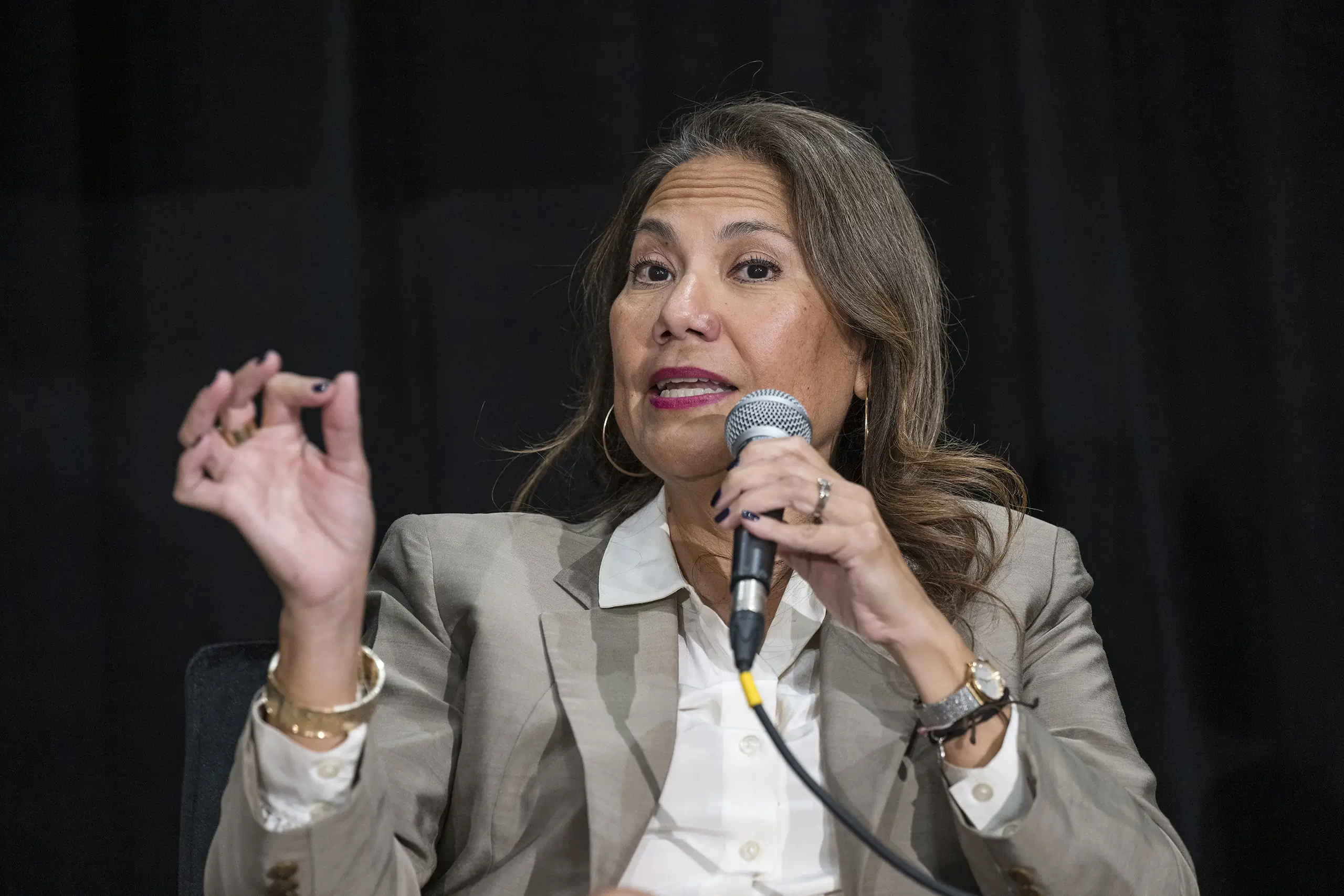
WASHINGTON — When Democrats took control of Washington after the 2020 election, Rep. Veronica Escobar thought comprehensive immigration reform was within reach.
It didn’t work out that way.
Recommended Videos
The El Paso Democrat helped craft a bill party leaders introduced at the start of Joe Biden’s term to create an eight-year pathway to citizenship for the millions of undocumented immigrants living in the country. But the Democratic legislation never got enough buy-in within the party and was deemed a non-starter by Republicans.
The episode was instructive for Escobar, who succeeded Beto O’Rourke in Congress halfway through Donald Trump’s first term and, in short order, made her name as an authority on immigration among House Democrats.
“It was a real wake-up call for me on the politics within my own party,” Escobar said. “It really was during that first two years of the Biden administration that I realized, No. 1, we’re not going to get this done as a Democratic-only bill. No. 2, it really is going to need to be bipartisan if it’s going to stick. And No. 3, I think we’re going to lose elections because of immigration.”
After Republicans rode the issue to a House majority in 2022, Escobar changed tack. She teamed up with Republican Rep. Maria Elvira Salazar, a Cuban American who represents a heavily Hispanic district anchored in Miami, to write an immigration reform bill called the Dignidad, or Dignity, Act. Crafted “in some respects in secret” to avoid momentum-sapping backlash, Escobar said, the compromise that emerged included a pathway to work and travel authorization for long-term undocumented residents and a mandate for employers to check staffers’ work authorization status.
They re-introduced the bill last year, with a key change to make it more palatable to Republicans, as the political battlefield on immigration was veering from the now-quiet border to Trump’s mass deportation push.
In turn, the new Dignity Act has sparked an emerging debate that reflects the shifting political realities for both parties around immigration. Democrats, acknowledging that some Biden-era immigration policies were out of step with the electorate, reined in a key sticking point of the bill’s prior version by removing the pathway to citizenship beyond DACA recipients. Yet, there would still be a way for undocumented immigrants to get temporary legal status, a point that’s the crux of the GOP’s disjointed response to the bill.
What emerges is a picture of an uneasy Republican coalition in which business leaders, grassroots conservatives and the Hispanic voters who helped power Trump’s 2024 victory all lack alignment on how to proceed.
Through the careful building of a coalition — Escobar and Salazar only let cosponsors join in bipartisan pairs — the Dignity Act is now up to 40 cosponsors, half in each party. In Texas, that includes Rep. Henry Cuellar, D-Laredo, and Rep. Monica De La Cruz, R-Edinburg, both in the moderate wings of their party.
But at the same time, the Dignity Act has unearthed a wave of conservative opposition, led by a fellow Texan, Flower Mound freshman Rep. Brandon Gill. Gill has been the tip of the spear in the pressure campaign against the bill, calling it a betrayal of conservative values and tantamount to offering amnesty, a dead letter in the GOP.
“The glue that held that [2024 GOP] coalition together was the mass deportation message that we ran on, because that is something that — particularly for working-class voters — resonates,” Gill said. “Because they’re the ones whose communities are being transformed. They’re the ones whose wages are being suppressed or whose jobs are being taken by this mass influx of illegal aliens that Democrats, by the way, created.”
To that end, Gill, an emerging force in the GOP, has sparred with Salazar about the bill on social media and made a point of endorsing candidates in Republican primaries who share his commitment to a more hardline immigration policy.
The Dignity Act doesn’t have support from GOP House leadership, and has no obvious pathway to passage at the moment. But despite the backlash, Escobar still sees a window — though narrow — for action, especially as Trump’s polling on immigration slips.
“There is an acknowledgment from the [Republican] side that the status quo cannot remain,” Escobar said. “I do think this is the moment. If we don’t get it done before August recess, it’s going to be really hard to get it done in the future.”
What’s in the bill
For decades, the basis of any immigration compromise has been a pathway to citizenship for undocumented immigrants — a priority for many Democrats — in exchange for heightened border security, a Republican priority, and stricter employment verification. Efforts to break through the impasse have repeatedly fallen short, establishing bipartisan immigration reform as one of Congress’ legislative white whales.
The Dignity Act has a different framework. It includes a modified version of the DREAM Act, which would offer conditional permanent residency status and eventual citizenship to DACA recipients, or people brought to the U.S. as children who have lived most of their lives here.
But aside from Dreamers, there’s no pathway to citizenship for undocumented immigrants in the bill — the key change from the 2023 version. Instead, they can earn legal status through the Dignity Program — a seven-year pathway contingent on passing a criminal background check, paying $7,000 in restitution plus taxes owed and providing proof that the applicant worked or was in school for at least four of the seven years. Dignity status, which authorizes holders to work and travel freely, would last for seven years and could be renewed indefinitely for recipients in good standing.
“Dignity is not amnesty,” Salazar said at a press conference last year. “Dignity does not grant a path to citizenship to anybody. Dignity is the Solomonic way to fix a 40-year problem.”
Crucially, the Dignity Program is only eligible to immigrants who arrived in the U.S. before the end of 2020 — meaning any migrants from the Biden era are ineligible. And those who have achieved Dignity status are barred from claiming means-tested federal benefits or entitlement programs.
Escobar said a common criticism she heard “and totally understood” during the Biden administration was frustration over new arrivals getting work authorization while older immigrants who had been in the U.S. for decades never did.
“Even within the immigrant community, with mixed-status families, there was a sense that it was profoundly unfair,” Escobar said. “And this bill tackles that head-on.”
The funds generated from the Dignity program would go to apprenticeship and skills training programs for U.S. citizens.
The bill also reforms asylum and employment practices and bolsters border security. It phases in a requirement that employers use E-Verify to confirm the work authorization status of their employees. It funds border security infrastructure, including “physical barriers,” and technology and raises pay for some Border Patrol agents. And it overhauls how asylum works, including an end to the controversial catch-and-release practice.
Asylum cases would need to be determined within 60 days, and applicants would be screened and held in newly built humanitarian campuses. Those whose asylum cases are denied or who fail their credible fear interview, which establishes eligibility for asylum based on potential for persecution or torture in their home country, would be subject to expedited removal.
In addition, the bill would expand opportunities for legal immigration, doubling the per-country annual cap for green cards, removing children and spouses from being counted toward caps on employment-based visas, and making changes aimed at whittling down visa backlogs.
The politics of dignity
As Republicans attempt to hold their coalition together for the midterms, Gill said he sees immigration policy — and mass deportation — as a unifying force, especially for keeping working-class voters under the GOP tent.
“That’s the glue that held the coalition together,” Gill said. “So I think to betray that, to go back on our word on the core thesis of the last election cycle, from a political standpoint, would fracture and, in many ways, just dissolve that coalition entirely.”
Across the Republican conference, Gill said there is “virtually no tolerance or appetite for amnesty of any kind.” He said GOP members who support the bill have told him they are mainly interested in codifying border security. But he thinks Democrats cannot be trusted on the issue.
Salazar argues the exact opposite, telling Politico that “what I’m doing is I’m really trying to preserve the Republican base that gave victory to Trump,” particularly the new Hispanic voter converts.
A White House official said the Trump administration is “always happy” to review congressional proposals but declined to weigh in further on the bill, saying they were “focused on enforcing the current immigration laws and deporting the millions and millions of criminal illegal aliens that Joe Biden let in our country.”
Among Dignity Act supporters, the list of cosponsors includes numerous members in competitive districts, but also some of the more ideologically driven politicians in both parties. Escobar said there’s a Democratic wait list for members to get on the bill once they can be paired with a new GOP cosponsor.
The proposal has earned the support of business groups and immigration advocates alike, from the libertarian group Americans for Prosperity to the U.S. Chamber of Commerce to the liberal pro-immigration group FWD.us.
In the Lone Star State, the Texas Business Leadership Council and the Texas Restaurant Association have signed on as endorsers.
Justin Yancy, the president of the TBLC, said he often hears from construction and agriculture industry leaders, in particular, about the need for immigration reform. While his organization strongly supports the goal of a secure border, Yancy said, he also wants to see new pathways to legal immigration, such as those in the Dignity Act, in order to meet labor needs.
A mass deportation strategy, by contrast, is not economically viable, he said.
“Deporting everyone would be catastrophic for the economy — not just in Texas, but around the country,” Yancy said. “That’s just a nonstarter.”
Texas, Yancy said, needs “more employees, not fewer”. And people eligible for Dignity status under the bill would not be taking jobs, he said, given labor shortages that are causing economic upheaval in key industries.
The vociferous opposition of Gill and others speaks to the increasingly strained relationship between big business groups and the GOP. Gill said if the GOP wants to be the party of the working class, it has to reject business’ arguments on immigration.
“Mass migration does, in many ways, at least in the short term, benefit large businesses who basically view these people as labor input,” Gill said. “But the people who are harmed are the people whose jobs are taken away. And those are the people who don’t have fancy lobbyists in Washington, who can’t spend millions of dollars on political campaigns, but they’re the ones who show up and vote.”
But while Gill still sees immigration as Republicans’ strongest issue, Escobar thinks there’s an opening for bipartisanship.
She saw the recent head-rolling at the Department of Homeland Security, including the ouster of Kristi Noem as secretary and Greg Bovino as Border Patrol sector chief, as evidence that the White House recognized it needed to change tactics on immigration.
“Does that mean they will embrace the Dignity Act?” Escobar said. “I think it depends on whether a lot of these groups lobby the White House directly. Because ultimately, if Donald Trump gives his blessing, it’s done.”
Disclosure: Politico, Texas Business Leadership Council and Texas Restaurant Association have been financial supporters of The Texas Tribune, a nonprofit, nonpartisan news organization that is funded in part by donations from members, foundations and corporate sponsors. Financial supporters play no role in the Tribune’s journalism. Find a complete list of them here.