
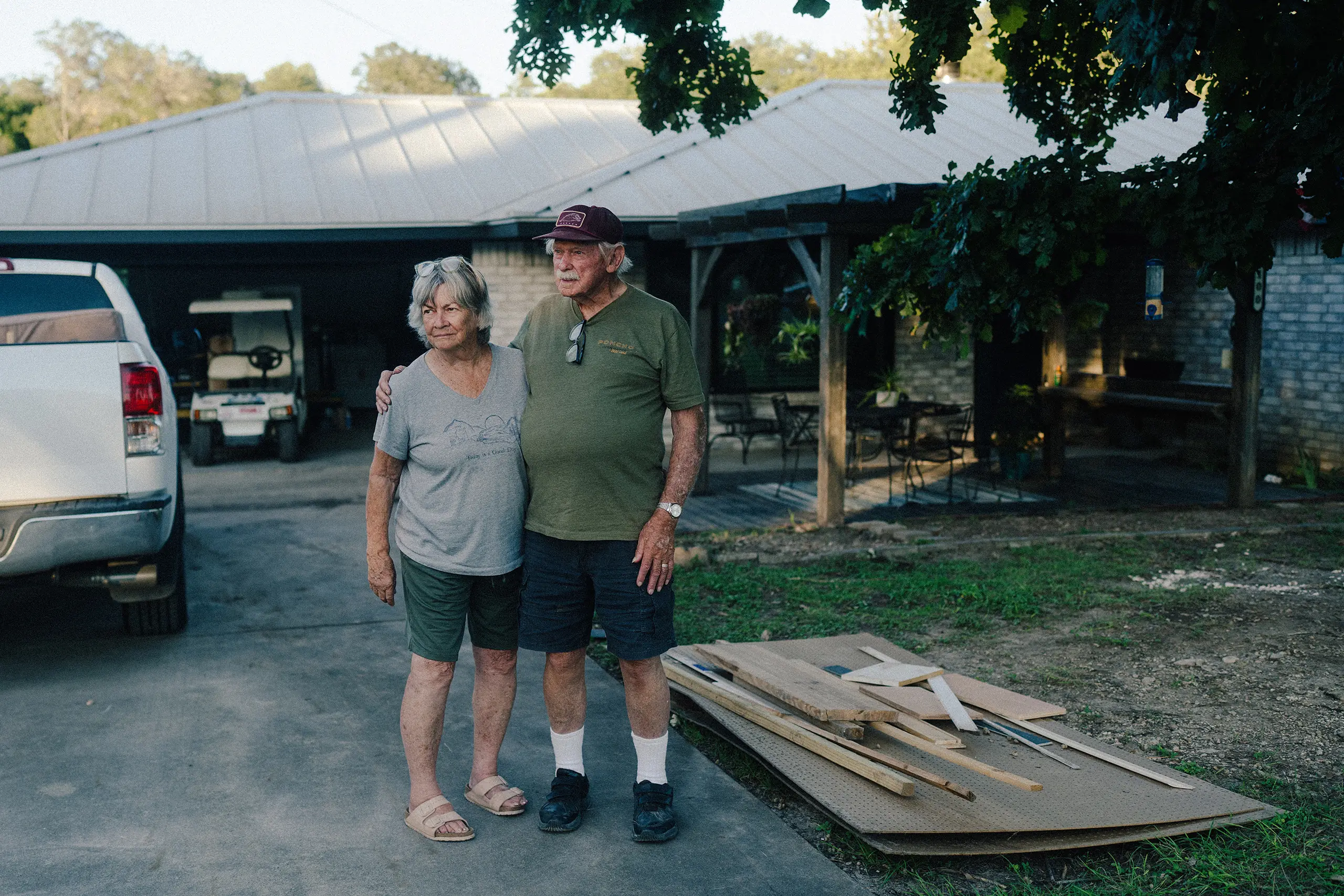
KERR COUNTY — Joan Connor, 82, didn’t expect another horrific flood to happen again in her lifetime. But two-and-a-half weeks ago, she found herself hurrying home from a Colorado trip with her 99-year-old husband to the house they’d just rebuilt after last summer’s flood nearly drowned them.
The floodwaters soaked the rug under the new grand piano Connor just bought to replace the one she lost. It totaled her Chrysler Pacifica that took the place of her old truck. It muddied her husband’s tools they’d salvaged last year.
Recommended Videos
Connor set up a dehumidifier by the piano and got rid of the car and a volunteer group helped clean the tools. Concerned about mold, they again looked for a place to stay in their RV while they fixed their home.
“I don’t care if I end up with zero money in my bank account; I’m going to pay people to get things done,” said Connor, a retired teacher. “We’re tired, and it’s a pretty house when it’s all done.”
When the Guadalupe River flood tore through Hunt, Kerrville and Center Point last year, Connor and many others thought of it as a once-in-a-lifetime storm. The National Weather Service characterized it as a thousand year rainfall — which has a 0.1% chance of happening in a given year.


The July 4 flood struck in the dead of night and traumatized this Hill Country community, killing 119 people in Kerr County, including 27 campers and counselors at Camp Mystic, and sweeping homes off their slabs.
Just over a year later, on July 16, it happened again — another once-in-a-lifetime rainfall. The main difference was where the rain fell, slightly northeast of last year’s deluge. This flood damaged some of the same homes and businesses, in some cases soon after people got them fixed. It ravaged other neighborhoods and businesses anew.


Now people are again facing the physical and emotional toll that can come with living in Flash Flood Alley: mucking out molding homes, piling ruined belongings by the curb, trying to salvage photos, knitted blankets or grand pianos.
Some locals say selling their properties makes no financial sense, even if they wanted to leave. Others couldn’t imagine leaving a place where they have friends, family, jobs.
For the second straight year, they’re encouraging each other. The Federal Emergency Management Agency as of Friday hadn’t approved funding to help individuals recover. Nonprofits have described the difficulty of soliciting donations a second time around.
But still, people are rebuilding. Strangers helping strangers. And grieving again.
“Last year, you’re devastated,” said Laura Cane, who had reopened her vacation rental house in Center Point three weeks before this year’s flood. “This year, you’re broken.”
Flooded twice, but staying
Eleven years ago, Cane and her boyfriend bought the property, which also has two long term rental homes. A mechanical engineer who designed drill bits and lives north of Houston, the 65-year-old retired with the plan of living off the rental income.
Last year they had to rebuild when the flood swept through the buildings.
Cane and her boyfriend got the vacation rental open again June 26. They were putting the finishing touches on the long-term units when this year’s flood arrived, causing worse damage than the first one. The water rose over the new cabinets and ripped stone from the exterior of one structure.
There’s no way, Cane thought as she watched the news that day.
The couple plans to fix everything again. They don’t want to take the financial hit of selling it now when the value is low after two straight floods.
“It sucks,” Cane said. “It’s horrific. It’s mentally, physically, financially horrific. You wouldn’t want anybody to deal with that. But at the end of the day, my family has a family to go home to.”
-

SLIDESHOW: A road closure on Arcadia Loop in Kerrville after the July 16 flood, on July 28, 2026. Brenda Bazán for The Texas Tribune -

A shed displaced by floodwaters sits on a flood-damaged road in Kerrville on July 28. Brenda Bazán for The Texas Tribune -

Damage from the July 16 flood on the Arcadia Loop bridge. Brenda Bazán for The Texas Tribune -

Another view of damage on the bridge. Brenda Bazán for The Texas Tribune -

Almost two weeks after the July 16 flood, the Arcadia Loop bridge in Kerrville remains clogged with detritus. Brenda Bazán for The Texas Tribune -

Badly damaged patch of road on the Arcadia Loop in Kerrville . Brenda Bazán for The Texas Tribune
Twenty miles away, past Kerrville, Jack Hudson, 62, and his wife had survived the 2025 flood on their porch, standing on a short rock wall and gripping decorative iron columns, worried the house would fall apart. Hudson held onto his 150-pound Great Dane while his wife held their 20-pound dachshund.
She thought they saw someone coming to save them; it was their truck floating by.
Four-and-a-half feet of water got into the home, ruining his mother’s handwritten children’s stories about Billy Wiskers, a mischievous goat, and 21 years of his journals. When the water receded, he helped move a body from a neighbor’s mobile home. He didn’t journal anymore after that.
“The community is exhausted, unfortunately,” Hudson said. “We’re deeply saddened to see the same thing happen again.”

This year when Hudson saw the creek rising, he got his dogs in the truck and drove up the hill. His wife was out of town. They had just moved back into their home in February and reopened their handmade wood furniture business in April. He preferred to start over here, where people knew him.
This time, Hudson lost only some lumber. People reordered furniture he’d made that washed away. He empathized deeply with those hit harder downriver who also had to close businesses.
“It can be tough,” he said. “It kind of knocks you down.”
“It’s been a hard week emotionally just to know what they’re going through,” said his wife, Jennifer Hudson, 62.


Michael Ybarra, who installs septic systems, could only think about last year’s flood when this year’s hit. His cousin, Julian Ryan, died a year ago when he punched through a window to save his family as the water rose; he bled to death when the glass gashed his arm. Ryan and his family lived near Hudson, who had helped carry Ryan’s body from his mom’s mobile home.
“All I could think about that night was my cousin and what happened to him,” Ybarra said. “I’m like, ‘What if I’m in that same situation?’ I didn’t know.”
Ybarra and his family got out of their Kerrville-area home as soon as they could after this year’s flood. They didn’t go back for a week, while they tried to find help; everything stunk from the wet and the heat.
Volunteers from Samaritan’s Purse helped Ybarra gut the home. They helped take everything out and spray it for mold. They cut out the drywall, leaving some evidence of his daughter’s scribbles high up on the wall. His 6-year-old daughter is autistic and nonverbal; the change in routine hit her hard.
Ybarra said they’re rebuilding because they own their home, so it makes the most financial sense. His wife has lived there for much of her life, and it’s where they lived during the birth of their two children.
Ybarra said Kerrville is all he knows. So they will take it day by day, with trust in God.
“It’s more than just a house,” he said.


“You remember this”
The flood hit people this year who were spared last year — Ybarra’s mother-in-law said it helped them better feel what everyone else went through.
For Julie Casteel, 48, buying a home felt like a big deal. She’d moved to Kerrville in 2018 to be part of the recovery community. She stayed in a domestic violence shelter and sought help with her with substance abuse. She had experienced homelessness. In Kerrville, she fell in love, and she and her husband moved into their home in October, on a hill.
Last year’s flood missed their house. This one didn’t.
Casteel’s husband Dan, 68, sprung to action. He had once built outdoor fireplaces and other outdoor amenities for a living, and he grabbed a Shop-Vac and pond pump to move water from one room into another, and sawed a notch into the concrete door frame in the house to let the water flow out.
His quick response spared them from having to rip out the flooring or walls — but camping gear, cycling equipment and power tools got drenched. So did photo albums. Casteel had moments of feeling anger and defeat over all she lost, at the idea of starting over again.


“This wasn’t supposed to happen,” she said.
Casteel and her husband both work for a state hospital, where she expects trauma. But their stone home was a safe place as well as a sanctuary for her 15-year-old daughter and the dogs and wild animals Casteel took in — including three snakes, a prairie dog, a rat and an opossum.
Julie Casteel went to work the day of the flood, and got notifications on her Ring camera as a community of people arrived at her home while she was gone to help clean up. Michelle McGuire, who had survived last year’s flood by swimming to a tree, kept checking in on her and suggesting resources.
“We’re rolling up our sleeves and doing it again and helping each other,” McGuire said.
Ties like those keep Casteel here.
“We take care of each other here,” she said.
Last year, Dondi Persyn, through a group called Found on the Guadalupe River, helped connect flood survivors with lost possessions that others found scattered along the river.
This year she’s helping clean out houses, paying for fans and dehumidifiers, and passing out bins for people to sort their flood-damaged stuff.
“We all were starting to settle our shoulders,” she said. “We got through the one year mark and we were like, okay, we can breathe a little bit. It felt hard, but also like okay, we hit that milestone, and then when the second flood hit, everybody was kind of in disbelief.”
She’s reminding the bewildered people she meets that even if the damage didn’t feel as bad as last year, it still mattered.
At Crider’s Rodeo and Dance Hall, a Hunt institution that flooded last year, forcing them to close for the remainder of the summer season, owner Tracy Moore had told her husband that if they flooded again, she couldn’t rebuild a second time.


Moore kept telling her grandkids: Never build a home by the river, no matter how serene it looks.
“You remember this,” she told them. “You remember this until you die.”
This year, their stretch of river rose again. And stopped short of the dance hall, sparing them.