

It’s that time again when the ‘heat high’ becomes the main character of the weather story. Sometimes the high can be relentless and result in endless days of scorching summer heat. So why do we call it a “heat high,” and why do we hear about it so often?

What is a high pressure system?
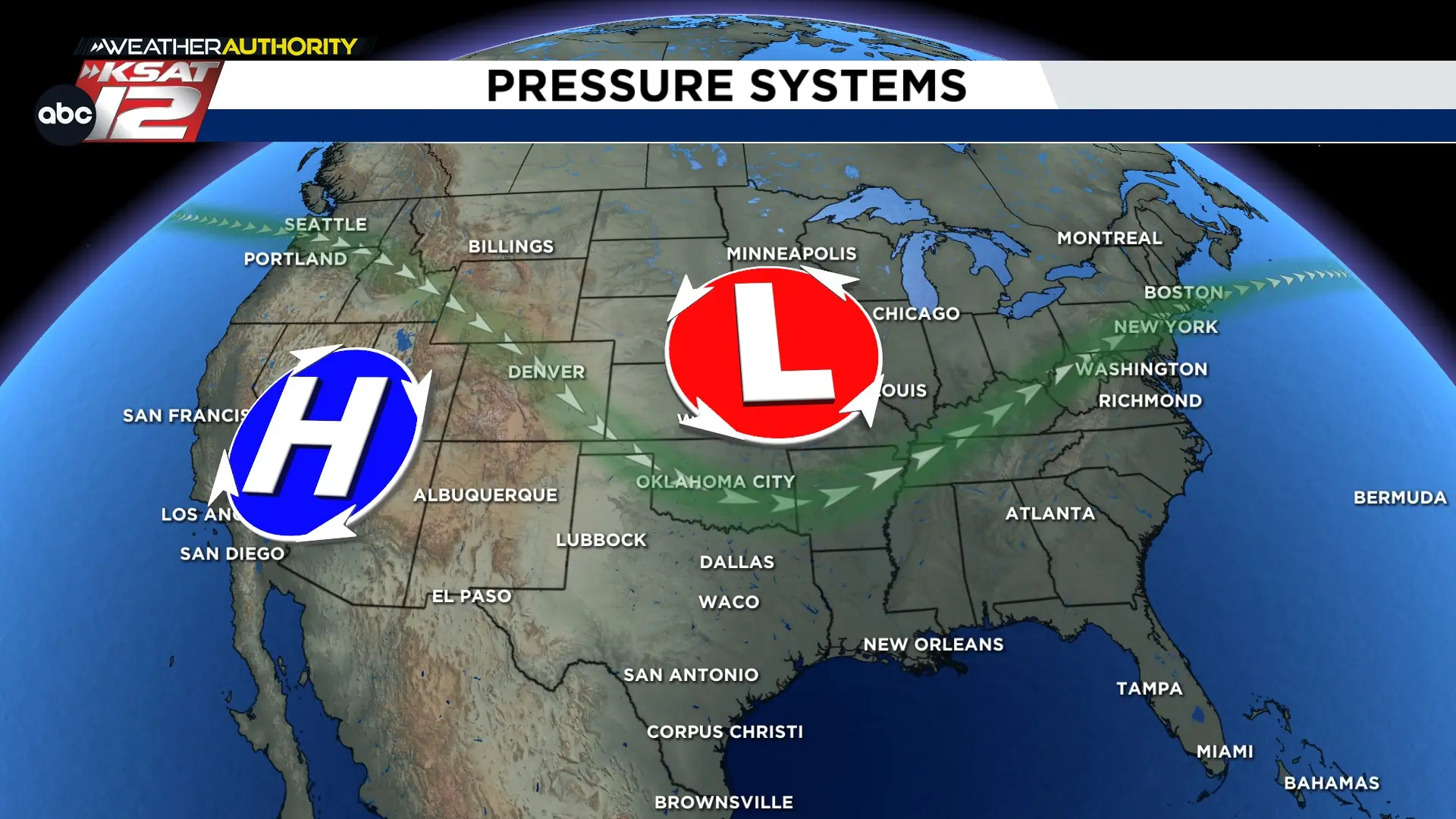
A high pressure system can cover Texas or the entire southwestern United States. Air pressures are highest at the center, and wind speeds flow clockwise around the system.
Cloud cover is prevented within an area of high pressure because air is sent downward. Thus, sinking air does not allow clouds and therefore prevents rain from developing.
Highs are known to trap heat, which can spike temperatures and easily result in streaks of above-average temperatures.
Why is high pressure always around?
High pressure systems are moving and developing all over the world. We always talk about it in the summer because our wind patterns become lax, and the jet stream doesn’t constantly drive weather systems into Texas or the southern United States. As a result, temperatures rise, pressure builds and our weather can stay pretty quiet until the next low pressure system arrives.
The longest-lasting high pressure system
In San Antonio, the longest stretch without rain was 63 days in 1993, from June 26 to August 28. A high pressure system dominated our area the entire time!
If you want to get more technical about the development of a high pressure system, check out the explanation below.
How does air move?
The best way to determine the weather is to understand what happens above controls our experience at the surface. The troposphere is the layer in our atmosphere where all weather occurs. At the equator, the troposphere can extend up to 12 miles above the surface. In all that “space,” air is constantly moving around as wind.
The movement of air is caused by the Sun’s radiation heating the Earth’s surface. The air will rise as it warms, but the Earth’s rotation causes the air to be turned to the right in the Northern Hemisphere. At the same time, the air will cool as it travels higher in the troposphere. Altogether, this creates circulations that we know as the Hadley, Ferrel and Polar cells.

Where does a high pressure system develop?
In the troposphere above 30° latitude, there is a convergence of air from the Hadley and Ferrel cells. This accumulation of air results in higher pressure, which also happens to occur over southern areas of the United States. Thus, having a high pressure system over Texas is almost a natural phenomenon. Air always wants to move from areas of high pressure to low pressure. Over time, this would balance out pressure levels, but that’s never the case.
Conditions under high pressure
As the air is moving in the form of wind, it also has a temperature. In the case of a high pressure system, air is typically warmer because clouds are prevented from forming, and allows the air to be heated efficiently. Warmer air essentially creates a feedback loop for a high pressure system because the warm, energized air molecules can also increase air pressure.
When do we get a break?
We might say a high pressure system is parked over us, but the occurrence is usually temporary. What helps steer all our weather is the jet stream. This stream of fast-moving air drives high and low pressure systems and their resulting temperature and weather phenomena across the world.
QUICK WEATHER LINKS
- Download FREE KSAT Weather Authority App: Up-to-date forecast information and livestreams from trusted local meteorologists.
- KSAT Connect: Share your weather photos.

KSAT meteorologists keep you on top of the ever-changing South Texas weather.
