
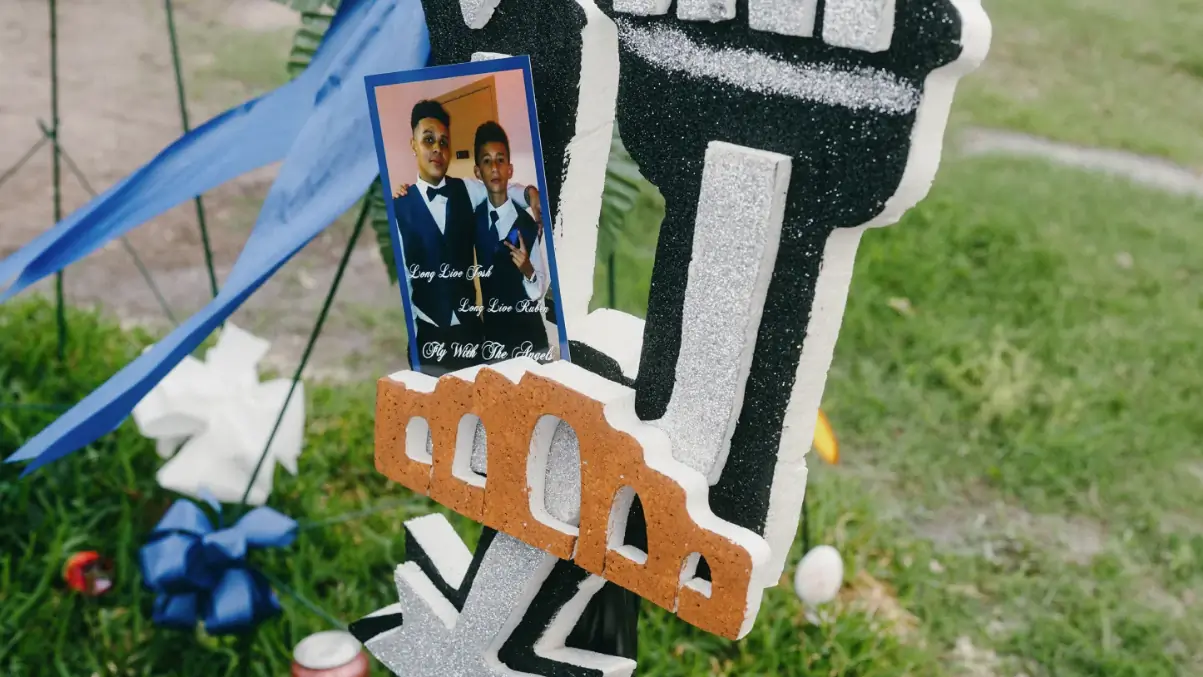
The last words Joshua Orta heard his childhood best friend utter were “I’m sorry.” Then Ruben Ray Martinez, a slender 23-year-old, slumped back in the driver’s seat. An officer had fired repeatedly through the open window, at least one bullet piercing Ruben’s heart.
Josh, 25, saw officers in South Padre Island drag Ruben out of his car that night in March 2025. They dumped Ruben’s body onto the roadway where they handcuffed him while he appeared unconscious, according to body camera footage. Law enforcement forced Josh into a police car, where he remained for more than four hours before officers moved him to a windowless interrogation room at around 5 a.m.
Ruben, police told Josh, was dead.
Three hours later and about 300 miles away, a state trooper pounded on the door of Ruben’s San Antonio home. His mother, Rachel Reyes, a 48-year-old nurse and health insurance administrator, heard the officer’s words: “On behalf of the State of Texas, we regret to inform you that your son, Ruben Martinez, passed away last night.”
There had been an accident in the Rio Grande Valley. Ruben, who had never left San Antonio on his own before, wasn’t involved in the crash. He came upon it by chance then went down a lane that he “wasn’t supposed to” and “tapped” an officer with his car, the trooper told Reyes. Another officer shot Ruben.
“Oh my God, I’m so sorry,” exclaimed the mother, who in her shock defaulted to an apology. “Is the officer hurt?” she recalled asking. No, the trooper said, the cop was fine.
It would be almost a year later when Reyes and Josh would finally learn that the man who shot Ruben was a federal immigration officer — a revelation that stoked their grief and ignited fresh anger at the government after months of unanswered questions.
That finding, exposed by a national watchdog group’s unrelated lawsuit in February, so shocked and enraged Josh that his family believes it may have contributed to his death hours later in an alcohol-fueled car crash. For Ruben’s mother, a former Trump voter, the government’s obfuscation regarding the details of the night destroyed her trust in institutions she previously respected.
They didn’t realize it, but Ruben’s death would be the first known killing by immigration agents of an American under Trump’s second administration. By comparison, the Minneapolis slayings in January by immigration agents of Renée Good, a mother of three, and Alex Pretti, an armed nurse with a gun permit, roiled the nation. Both were white, middle-class and protesting immigration enforcement, and their killings were broadcast in almost real time to the world. Ruben, a Hispanic man born and raised in San Antonio, had never protested and few civilians have come forward about their footage of his death.
Whereas local prosecutors in Minneapolis charged at least one immigration agent there with assault for their alleged actions during that crackdown, a Cameron County grand jury declined this spring to indict officers in Ruben’s slaying.
Reyes said that the apparent reluctance of authorities to provide details and accountability for what happened has her believing that the government is trying to “cover up” its mistakes in her son’s death. She now views that as a “pattern” by the Trump administration in attempting to evade responsibility for suspected failures.
“This is a young, sweet, funny, silly boy who spent his first night outside of his home,” Reyes said in her first public interview from her home. “He did not deserve this.”
Spokespeople for the Department of Homeland Security and Immigration and Customs Enforcement did not respond to detailed questions. Neither did the South Padre Police Department, Cameron County District Attorney, nor the Texas Department of Public Safety overseeing the Texas Rangers investigating the shooting.
Acting ICE director Todd Lyons responded in an email that his agency stands by the grand jury’s finding that the federal agent should not be criminally charged.
“This incident was investigated from every possible angle by an independent body, and it cleared our officer,” said Lyons, declining to answer other questions, including about the involved officers’ training, history or experience.
Josh’s mother Virginia Mandujano, who has never before spoken publicly, also called for accountability, saying she believes her son perhaps wouldn’t have died in that manner if he had not been so tormented by witnessing the death of his friend. Immigration agents are there for “one purpose only and that’s to deport. Not to play cop,” said the 46-year-old home health aid in an interview.
When Josh finally made it home to San Antonio from South Padre, he was exhausted. As the eldest boy, he was not one to cry, but he was sobbing, alarming his family who had never seen him in such a state.
“They shot my best friend Ruben, like they just shot him,” his brother recalled Josh telling him. “I legit watched my friend die right in front of me.”
Later that evening, Josh posted a story of him and Ruben on Instagram: “Lost my bf last night my head fuked up but we gone meet again.”
Conflicting accounts
Josh and Ruben met in kindergarten, their families said, and instantly became friends. Neither were close to their biological fathers, who had separated from their mothers when the boys were young. As Catholics growing up in San Antonio’s largely Hispanic South Side, both knew to respect law enforcement. Their mothers had instilled that in them, a belief in part bolstered by their proximity to Lackland’s U.S. Air Force Base.
The boys shared a passion for basketball, both playing it and rooting for the city’s beloved Spurs. The two spent hours every week shooting hoops at their neighborhood Catholic church’s court. Otherwise, they were typically at Josh’s house playing video games or battling over beer pong and pool.
When Ruben suggested that they go to South Padre to belatedly celebrate his 23rd birthday, Josh agreed. They arrived late Friday afternoon and spent the evening drinking with friends, Josh later told police. Shortly before midnight, they stopped at a Whataburger. On their way back to the apartment where they were staying, they encountered a car accident that blocked the busy spring break destination’s main thoroughfare, drawing law enforcement from across the region who were attempting to redirect traffic. Footage shows several drivers confused about where to go or what to do.
Ruben slowed his blue Ford Fusion to a crawl as he tried to navigate away. He was unfamiliar with the island’s streets. At first, officers waved Ruben forward, footage shows. But then one officer spotted a bottle of Crown Royal whiskey, according to the footage.
“Pull over right there,” the officer shouted. “Open container!”
Josh, who was in the passenger seat, told investigators that he heard the commands and believed Ruben continued because he feared being arrested for driving drunk.
Compounding the chaos, at least one officer yelled instead at Ruben to “keep going,” according to the footage.
Ruben stopped at a pedestrian crosswalk to allow people to walk past, then slowly turned onto a side street. Footage shows his brake light on.
What happened next isn’t clear from the available video because neither of the federal officers had on body cameras and those by local law enforcement, who were further away from the shooting, did not entirely capture the seconds in question.
The ICE agents, Jack C. Stevens and Hector Sosa, told the Texas Rangers that Ruben didn’t heed instructions, so a few officers surrounded his car. Ruben “accelerated forward” and “drove so close” to Sosa that he “bumped his legs with the front bumper after telling him to stop.” Ruben swerved, causing Sosa to “fall onto the hood” of the car, the agents maintained.
Sosa’s colleague Stevens, assigned to the maritime unit with Homeland Security Investigations, claimed that he could smell marijuana from the car. Ruben’s eyes, the agent wrote, were “open widely, fist clenched to the steering wheel.”
“This is a behavior I have observed in my training and experience as a pre attack indicator and sign of noncompliance as the suspect is looking in the path of their intended movement and is not indicative of compliance,” Stevens wrote. “This path of movement, if left unmitigated, would, using the vehicle as a weapon, have resulted in numerous casualties.”
Stevens alleged Ruben’s car hit him slightly, causing the youth’s car mirror to break off. He wrote in a statement that he “feared for the safety and life” of himself, Sosa, other officers and pedestrians. Recent attacks in which drivers used their vehicles, including one in New Orleans three months before when a man rammed a truck into a crowd on Bourbon Street, remained “fresh on my mind,” Stevens wrote.
Ruben’s attorneys, however, said updated footage later released by the state police shows that at the time gunshots were fired, the car was stopping. That, attorney Alex Stamm argued, shows Ruben“didn’t place anyone in danger of death or serious injury, and that it wasn’t legally or morally justifiable to kill Ruben in these circumstances.”
Josh in his videotaped interview with officers also questioned law enforcement’s account. Ruben “panicked,” Josh acknowledged. As Ruben slowly turned, Josh saw an officer “on the hood” of the car. But Ruben didn’t hit the officer, Josh told police, rather he “caught his feet.”
Months later, in a statement to Ruben’s lawyers, Josh told them that the officer “seemed to be trying to get in front of the car, like he wasn’t moving out of the way when we tried to turn around and leave like the police officer told us to do.”
Ruben, Josh said then, “never hit the gas. The troopers were never in danger from Ruben and could have easily stepped aside while we tried to turn around and leave.”
A DHS spokesperson said that its agents are trained to use “the minimum amount of force necessary to resolve dangerous situations to prioritize the safety of the public and our officers.”
Officers, the spokesperson added, are “highly trained in de-escalation tactics and regularly receive ongoing use of force training.”
The local medical examiner found that Ruben, who according to his lawyers had no previous criminal record, had a blood alcohol content of 0.12 – above the state’s limit of 0.08 – and traces of marijuana and Xanax, a painkiller.
An ambulance transported Ruben to the local hospital where he was pronounced dead. Sosa, the federal agent, also was rushed there for a knee injury. After a few hours, hospital staff discharged him.
Reyes grows restless
Days later, Ruben’s mother and sister, Cassandra, drove to South Padre to pick up his car. Local police had impounded it so the mother had to pay more than $600 for its release. His sister drove the Fusion back to San Antonio,the bullet casings that had killed her only biological brother still strewn about the car.
At Ruben’s funeral, his uncle read from Corinthians, “to be absent from the body is to be present with the Lord.” Ruben’s last communication with his beloved nephew and niece were “I love y’all, I’ll see y’all later.”
“Those words are still true,” the uncle, John Trevino, told the nearly 200 people gathered in Ruben’s honor at Mission Park Funerals, a mainstay of the city’s Catholic South Side. “It’s just going to take a little longer than expected.”
As the weeks drew on, Reyes replayed in her mind the few details officers had so far shared. It didn’t make sense. She scoured the news, finding only a brief mention days after Ruben’s death that an “officer-involved shooting” including a federal agency had occurred in South Padre.
At times, Reyes asked her husband if she should go to the media. Given the lack of documentation provided to her, she was having a hard time convincing lawyers to take on Ruben’s case. Her husband urged her to trust the process, have faith. Surely the Texas Rangers, one of the most highly regarded institutions in the land, would deliver justice.
Five months after Ruben’s death, his mother in late July received a startling letter from Amazon, where her son had worked for five years. Reyes had requested his life insurance payout, but an agent with Amazon’s insurance company wrote that the entity understood that had Ruben survived, he would have been charged with a felony, limiting her claim.
Reyes was stunned. While police had told her that her son “tapped” an officer, this was the most expansive information she had so far received alleging that Ruben was posthumously accused of a serious crime.
In her grief and confusion, she increasingly relied on Josh. He maintained that Ruben had done nothing wrong, a conviction that strengthened as time passed.
In August, Ruben’s mother found a Texas law firm willing to take on the case. Josh agreed to provide her lawyers a sworn declaration denying the government’s version of events. They wanted answers. But they hoped for justice.
“These claims are not true. I was there,” Josh wrote of the federal agents’ account. “Ruben was driving cautiously in traffic in his proper lane and certainly did not strike anyone with his vehicle.”
Josh added that Ruben’s family, particularly his mother, had been “left with no answers and no accountability. They have been denied transparency, and the official narrative conflicts sharply with the facts as I experienced them firsthand. Ruben did not deserve to die.”
“Survivor’s guilt”
Josh, like Ruben’s mother, struggled with the death. His family would often catch him lost in thought and knew that was when he was reliving his friend’s final moments.
“He couldn’t understand what happened,” said Josh’s mother. “He carried that weight with him.” He had “survivor’s guilt.”
Josh became more religious and began getting tattoos — Catholic imagery and “Ace,” a nickname for Ruben. Josh started drinking more, not every day, but more compared to before, his friends and family said. Josh abandoned his once obsessive weekly ritual of cleaning his prized Infiniti.
Josh’s family worried. His stepsister, Starleen Arriaga, who was close to him because they were the same age and had grown up together, urged, “suicide is not the way,” adding, “you will never see Ruben again if you go that route.”
He assured her, “don’t gotta worry.”
But his recurring nightmares often bolted him awake in a sweat. He told his girlfriend, 22-year-old Michaela Benavides, that he had the growing sense that he would die young.
“I could be, you know, gone too,” he reflected to his siblings. “Life is not promised.”
Last fall, Josh moved into a two bedroom rental house with Benavides, who he told family was “the one.” Meeting her lightened some of Josh’s darkness. He adored her, she said, sometimes bordering on excess, like when he offered her $1,000 to spend at the mall for her birthday present.
“Let’s pay the car note first,” she joked.
Often she awoke to his sobs.
“I just don’t understand,” he would tell Benavides, she said. “Why did they have to shoot him? Why not me? Like, he was a good person.”
“Goodbye, one last time”
In late February, a friend texted Josh a news story declaring that ICE was responsible for Ruben’s death. The information was not revealed by the government but obtained in an unrelated public records lawsuit by American Oversight, a national watchdog nonprofit.
Josh, his friends and family said, was infuriated.
It had been weeks since ICE officials had killed Pretti and Good in Minnesota, spurring nationwide protests. But Ruben’s death had made no such stir.
“ICE is crazy,” Josh responded.
Hours later, he tried to conceal his anger during the birthday celebration for his 25-year-old step sister and his 19-year-old sister. It was in the family’s backyard and they decorated it with red balloons. Josh wanted the night to be memorable so as the gathering wound down, he suggested some go to a bar.
While he waited for Arriaga to change, he sat outside with his girlfriend. As they gazed at the stars, Josh told her “life is unfair. I wish Ace was here,”Josh said, referring to Ruben by his nickname.
Josh had been drinking — “he kept doing shots, and he was like, ‘here’s to life,’” Arriaga, his stepsister, said.
“I really feel like that party wasn’t even meant for us,” she added. “I feel like it was meant for him to say goodbye, one last time.”
At about 12:40 a.m. that Saturday, roughly the same time that Ruben was killed nearly a year before, Josh barrelled down Interstate 35 near downtown San Antonio with his girlfriend in the front and his stepsister and friend in the back of Josh’s Infiniti. Another car suddenly swerved in front, they said, forcing Josh into the exit lane. His stepsister and friends said Josh wasn’t able to slow down quickly enough, hitting a utility pole that forced the car to spin before ramming into a concrete barrier.
Josh’s stepsister, Arriaga, regained consciousness as one explosion hit. She and 22-year-old Gerardo Lopez scrambled out of the back as the car partially burst into flames. They tried to break the windows to help Josh and his girlfriend, but the pressure inside prevented them.
Benavides bolted awake. Turning to Josh, she saw blood trickling out of his mouth. He was slumped over and unconscious. Arriaga and Lopez knew there were at best a few minutes before another explosion would cause the car to ignite. They tried to wake Josh, but he didn’t respond. Get out, the friends yelled at Benavides.
She tugged at Josh. “Please baby,” she recalled. “I don’t want to leave you here. Wake up.” But he didn’t move.
Finally she crawled over Josh to climb out of the driver’s window. As soon as she exited, the car exploded, the force throwing back her and Josh’s friend. They begged the arriving emergency responders to save Josh. It was too late, they said.
ICE’s first victim
For the second time in less than a year, Ruben and Josh’s mothers convened for a funeral. Despite knowing each other’s boys for years, they had first met at Ruben’s service. Now they were at the burial for Josh before the first anniversary of Ruben’s death.
That Ruben and by extension Josh, in their view, were victims of ICE didn’t immediately register for either family. When their relatives heard about Pretti and Good, they had no idea that their sons, brothers, and loved ones could also be part of such an incendiary political narrative. They were not protesters. In fact, both families largely described themselves as apolitical.
Josh had been so badly burned that officials with the local medical examiner’s office requested his dental records to confirm his identity. His mother begged to see him but an official told her, “I really don’t think that’s a good idea.”
At Josh’s funeral this March, his brother played a 30-minute slideshow he had meticulously worked on, adding Josh’s favorite rap artists to the soundtrack and featuring dozens of photos of Josh and Ruben throughout the years. Here they are playing beer pong. There, laughing and shooting hoops. Here being silly at a bar.
In his prepared remarks to the congregation, Paul Mandujano said Josh “wasn’t just my big brother. He was my best friend.” He recalled how generous Josh was, offering advice and helping to pay the family’s bills when his relatives fell short. Before Josh died, he promised his brother that for his 21st birthday this April he would help him to buy a car.
“There have been moments where this pain feels so heavy it’s hard to even keep going,” Mandujano told the crowd. “What put me at peace is when Josh lost his best friend Ruben he was heartbroken and in pain and came to my room and leaned on me so I know my bro is finally up there with him.”
About a month later, Josh’s family attended a vigil for Ruben outside of San Antonio’s city hall. Josh’s brother spoke on behalf of the family, saying, “We refuse to let them use my brother’s death in vain to justify their actions. Justice will be served for Ruben and my brother.”
Everyone now knew that an immigration agent was responsible for Ruben’s death. His mother started giving a few national media interviews. The statement Josh had provided her lawyers, which he wasn’t able to sign before his death, also made headlines. So did Ruben’s mother’s revelation that she had voted for Trump in 2024, mostly worrying about the economy, she later explained. This is what you deserve for being part of a cult, some commentators declared. You are an awful mother, they told her.
Josh’s mother said that although she hasn’t voted in any recent elections since choosing Barack Obama in 2008, she now feels that immigration agents should be “reined in” and focus on Trump’s deportation mandate rather than “killing Americans.” In this case, the mother argued, two U. S. citizens are dead because of the federal government’s mistakes.
Butch Hayes, one of Ruben’s family’s attorneys, said that when history revisits this moment in which he accused ICE of playing “gangster in our streets instead of protecting our communities,” Ruben will be remembered as the agency’s “first victim.”
“ICE ended Ruben’s life for no good reason, and Joshua’s death eleven months later is a further manifestation of the injustice wrought by ICE,” the lawyer said. “No amount of spin from DHS will change the reality that two decent American families have been shattered by their lawlessness.”
Ruben and Josh’s mothers often find themselves speaking aloud to their sons. Josh’s mother, at his gravesite at a South Side Catholic cemetery. Ruben’s mother, in his room, which looks mostly how he left it, except for a blanket emblazoned with his image Reyes tossed over his unmade bed.
For a while, she kept Ruben’s ashes there, too, but then it dawned on her that it might make him feel lonely so she moved the urn to a prominent living room mantle “so he could be close.”
This article first appeared on The Texas Tribune.