
Brandon Mulder is a journalism fellow at the University of Texas Energy Institute.
In 2022, Ty and Leslie Eggemeyer received a notice in the mail that would shape the next four years of their lives. Their nearly 4,000-acre wildlife resort in Lampasas County — featuring everything from giraffes to wildebeests and gazelles — was along the route of a planned pipeline project proposing to connect the Permian Basin to the Gulf Coast.
Recommended Videos
Matterhorn Express, a pipeline entity majority-owned by the Austin-based infrastructure company WhiteWater Midstream, would transport Permian Basin gas 580 miles to the Houston area using the powers of eminent domain to sail through thousands of acres of private property.
On Artemis Ranch, the 42-inch pipeline would clip through just a half-mile strip of the property. But it would create an eyesore near the ranch’s entrance, visible to guests coming for wedding parties, corporate retreats and other events.

“We’ve been pushing our ranch as an eco-tourism ranch. How does that fit with a 42-inch gas pipeline running through the front entrance?” Ty Eggemeyer said.
To compensate, Matterhorn offered the landowners what it claimed was market value for the strip of land — around $21,000. The Eggemeyers refused, forcing the two sides into a yearslong legal battle that dragged on as the pipeline was built.
In April, nearly two years after the project went into service, the Eggemeyers and a packed Lampasas County courtroom listened as a jury delivered its final judgment. Matterhorn was ordered to pay them about $7 million for easement rights and property damages, a sum roughly 330 times greater than the pipeline company’s final offer.
“I had tears running down my face,” Eggemeyer recalled.
Tensions between landowners and pipeline companies over eminent domain are stirring up as Texas faces a surge of pipeline projects seeking to move more natural gas from West Texas oil fields. By 2029, several new gas pipeline projects are expected to be completed, three of which are slated to finish construction this year. All are spurred by either data centers thirsty for more electric power generation or liquefied natural gas exporters seeking to supply a turbulent global economy with American energy.
Caught in the middle are Texas landowners confronted with the power of Texas’ eminent domain laws, which attorneys say can trample on property rights while leaving landowners with little compensation.
In the overwhelming majority of cases, pipeline developers acquire easements through voluntary negotiations with landowners, where companies seek to achieve “fair, mutually beneficial outcomes,” according to Thure Cannon, president of the Texas Pipeline Alliance.
But when an agreement can’t be reached — such as in the case between Artemis Ranch and Matterhorn — companies file condemnation suits in state district courts, setting off lengthy and costly legal processes.
“Over 80% or 90% of landowners will negotiate 10% or 20% more than that final written offer and think they’ve hit a home run,” said Chris Johns, an eminent domain attorney in Austin. “But they haven’t. They got low-balled and they accepted it.”
Neither Matterhorn nor members of its legal team responded to requests for comment. On June 16, the company filed a motion asking the judge to overturn the jury’s verdict or schedule a new trial. The Texas Oil and Gas Association said developers have guaranteed that private property rights are respected while ensuring that pipeline infrastructure — a backbone of the Texas economy and global energy security — can be built.
“Because of the Lone Star State’s role as a global energy leader, the very same infrastructure that secures our local economy simultaneously provides stability to our allies abroad,” TXOGA President Todd Staples said in a statement. “Strengthening our infrastructure network allows us to deliver reliable energy that helps our global partners reduce their reliance on energy from hostile regimes.”

In good faith
Texas law grants eminent domain authority to private companies whose projects serve a public purpose, meaning that developers have the power to take private property from landowners if they can demonstrate that their project provides a public benefit.
In order for pipelines to meet this requirement, they must qualify as a common carrier — defined as those that transport products for one or more third-party customers.
The law also requires developers to make a bona fide offer to landowners, or an amount based on an appraisal of the property being condemned, and engage in good faith negotiations for a voluntary sale.
If a landowner rejects the offer, a developer can file a condemnation suit asking the court to appoint a special commission of three disinterested property owners from the same county to determine the proper compensation. A landowner can still reject that amount and continue the legal fight, but at that point the developer can take possession of the property as soon as it deposits the commission’s recommended price into the court’s registry.
But eminent domain attorneys say that the bona fide offer requirement has been weakened by the courts.
“The ‘bona fide offer’ is a joke,” said Jeff Mundy, an Austin-based environmental law attorney.
Several experts point to a watershed moment in 2004, when the Texas Supreme Court issued a ruling that changed how good faith negotiations play out.
Before 2004, landowners unwilling to give up their property were incentivized to drag out negotiations with developers for as long as possible. The longer negotiations take, the more likely companies are to sweeten their offer.
The 2004 case, Hubenak v. San Jacinto Gas Transmission Co., sought to end that strategy. The court ruled that any dollar amount offered by a pipeline company qualifies as a bona fide offer, and it’s not up to the courts to evaluate the reasonableness of the offer.
“Before the Hubenak case, there was this idea that the offer has to pass this subjective good faith test. That means you look at what everybody else is getting offered and so on, then try to divine the real value of the land,” said Chris Kulander, an oil and gas attorney and senior lecturer at the University of Texas School of Law. “You really don’t have to do that anymore.”
The case “assisted pipeline companies in bringing these condemnation actions to a speedier close,” he added.
Three months after the Eggemeyers first received the condemnation notice in the mail, Matterhorn obtained a temporary restraining order allowing the company to survey the land. Within two months, the company sent them an initial offer of around $38,000 for the half-mile easement, followed by the $21,000 final offer, both of which they declined.
“I don’t know how the state of Texas can equate a $21,000 offer as a bona fide offer,” Eggemeyer said.
Ahead of the jury trial, Matterhorn made a final pitch to the landowners — $3 million in exchange for settling the condemnation suit in addition to allowing the company to lay a second pipeline through their property.
With global demand for Texas natural gas rising, the company had plans to build a second, even larger pipeline that would run along the same general route as the Matterhorn pipeline. That project, known as the Eiger Express, is expected to begin carrying gas to the Gulf Coast in 2028.
The Eggemeyers declined that pre-trial offer, preferring to take their chances before a jury. But it was their first confirmation that the company aimed to install a second pipeline through their ranch.

The corridor effect
It’s not uncommon for one pipeline to multiply into several when developers use a right-of-way to install a second, third or fourth line, creating what several experts describe as a pipeline corridor.
In the region where the hills of Central Texas flatten into the rolling plains of the west, Babette Taylor and her family have been farming and ranching for six generations. But the previous 45 years have made Taylor an expert on Texas’ eminent domain laws and the pipeline corridor effect.
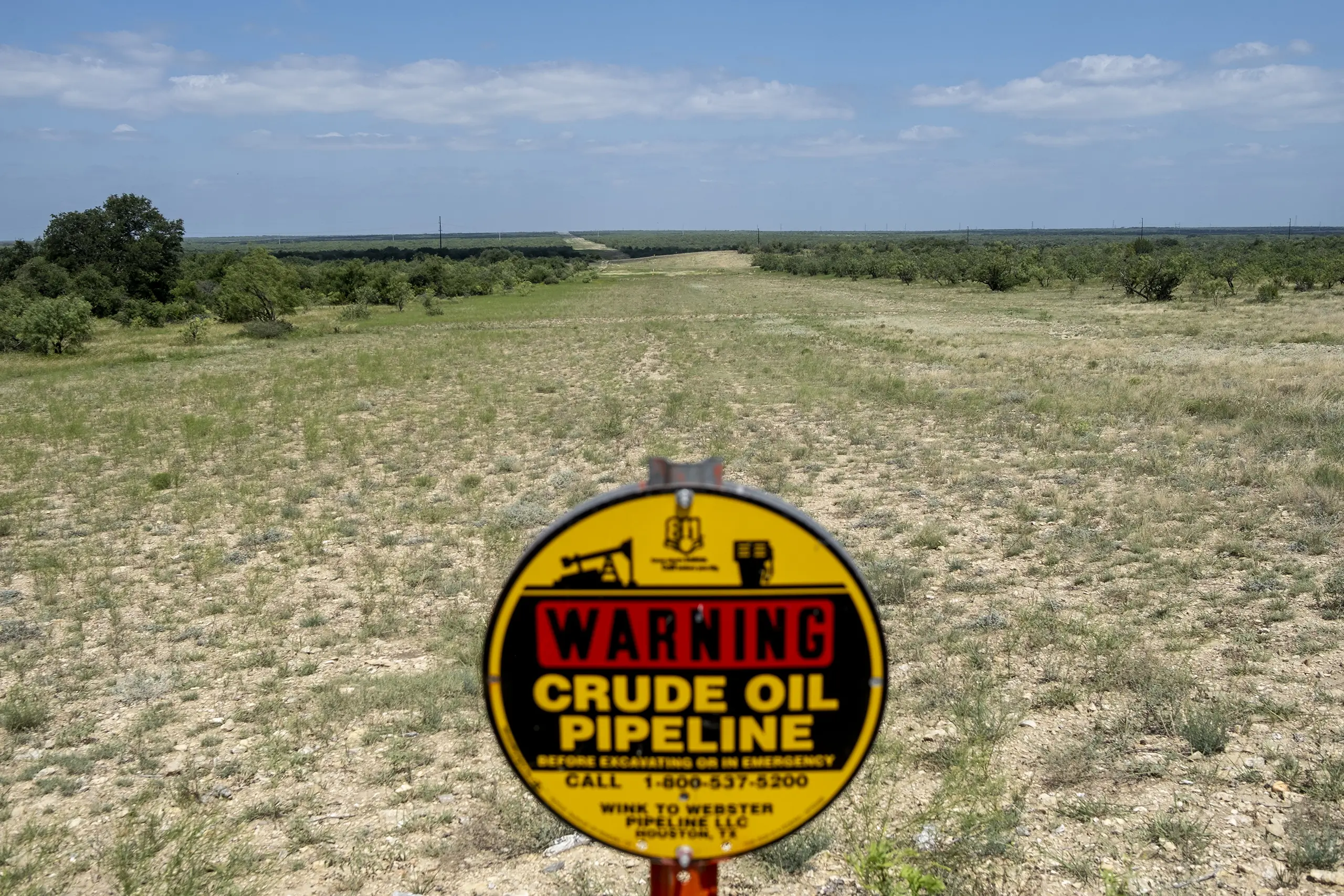
Sitting just east of the Permian Basin, Taylor’s ranch in McCulloch County is marked by a ribbon of cleared land stretching as far as the eye can see. Underneath is a thoroughfare of four pipelines shipping oil and gas to the Gulf Coast.
Taylor’s first exposure to the pipeline business was in 1981, when she recalls her parents discussing easement terms at their dining table with a landman representing a Houston-based company. Within two years, a natural gas pipeline was running through their ranchland from the Permian Basin to processing plants east of Houston.
The same company returned a decade later with a second pipeline project, then again in 2015 and 2019. Over the course of 40 years, the booming Permian Basin turned Taylor’s ranch into a pipeline corridor.


“Once these easement terms are signed, they’re in effect in perpetuity. You can’t go back and renegotiate,” Taylor said. “The land is burdened for eternity with those pipelines.”
With each subsequent project, the compensation to the landowner dwindles because every additional pipeline causes less harm to the property’s value than the one before.
“Something we tell our landowner clients is to make sure you do a really good job of getting compensation on the first one, because the second, third and fourth one that may come through, you’re not going to get compensated as well,” said Johns.
But to Taylor, any kind of upfront lump-sum payments leaves landowners with the short end of the stick. If for-profit companies are using her land to transport their products, the landowner should be cut into some kind of revenue-sharing arrangement, she argues.
And it’s an idea that has made its way to the Texas Legislature once before.
Capitol solutions
Few Texans have perhaps felt the strain of the state’s eminent domain laws more acutely than David Simpson, an East Texas Republican who served in the Texas House from 2011 to 2017. Simpson and his family-owned timber company, Avenger Timber, were embroiled in a 12-year condemnation suit filed by pipeline company Enbridge, which both sides ultimately settled out of court.
Simpson quickly gained a reputation in the Legislature for his ardent opposition to what he sees as government overreach, and his experience with Enbridge only bolstered his criticisms of Texas eminent domain laws, he said.

“Oil and gas companies are private, and they should be treated that way,” Simpson said. “My idea is they should pay a royalty for traversing your property against your will.”
As a freshman legislator, Simpson floated the idea of royalty payments so that property owners can benefit from the pipeline profits, and he filed bills proposing other landowner protections, although no bills made it out of committee.
Eminent domain reform efforts didn’t appear again at the Capitol until 2019, when a bill by state Sen. Lois Kolkhorst sought to prevent companies from making lowball offers to landowners, along with other protections. But the bill died in a joint House-Senate conference committee after another lawmaker led an effort to remove provisions that Kolkhorst said were critical for leveling the landowner-developer playing field.
Reform efforts finally gained ground in 2021 when the Legislature passed a version of Kolkhorst’s bill that failed in 2019. Although it did not address landowner compensation, it required companies to restore damaged land around a pipeline easement or compensate landowners for damages that aren’t restored, along with other transparency measures.
Kolkhorst described it as a first step to try to bring more balance to the process. Although numerous industry associations threw their support behind the bill, it struggled to gain backing from some landowner groups that felt it didn’t go far enough.

The Texas Pipeline Association described the reforms as a significant strengthening of landowner protections that resulted from years of negotiations with landowner groups and lawmakers. The bill “created a more consistent process for landowners while preserving the state’s ability to develop infrastructure that serves a public need,” Cannon, the Texas Pipeline Alliance president, said in a statement.
Of the six pipeline projects slated to come online by 2029, two will connect the Permian Basin to Dallas-Fort Worth’s growing data center market, where many facilities are expected to build their own on-site gas-fired power plants. Three would feed gas storage hubs along the Gulf Coast, where seven new export terminals are expected to double U.S. liquefied natural gas exports by the end of the decade.
“How can something be eminent domain-able if all the product is being piped to get put on a boat and shipped overseas?” said Allison Koester, a Coleman County rancher facing a proposed gas pipeline coming through her land on its way to the Gulf Coast. “Eminent domain should be for the good of the people impacted by it and the people that will be using it.”
As pipelines and transmission lines continue expanding across Texas and add pressure on rural landowners, the issue may percolate in the Capitol once again, said Kathi Seay, policy adviser for state Sen. Bob Hall, R-Edgewood.
“This is an issue that raises to the surface every couple of years with the gnashing of teeth, then quietly slides back below the surface,” Seay said.
Disclosure: Texas Oil & Gas Association and Texas Pipeline Association have been financial supporters of The Texas Tribune, a nonprofit, nonpartisan news organization that is funded in part by donations from members, foundations and corporate sponsors. Financial supporters play no role in the Tribune’s journalism. Find a complete list of them here.