
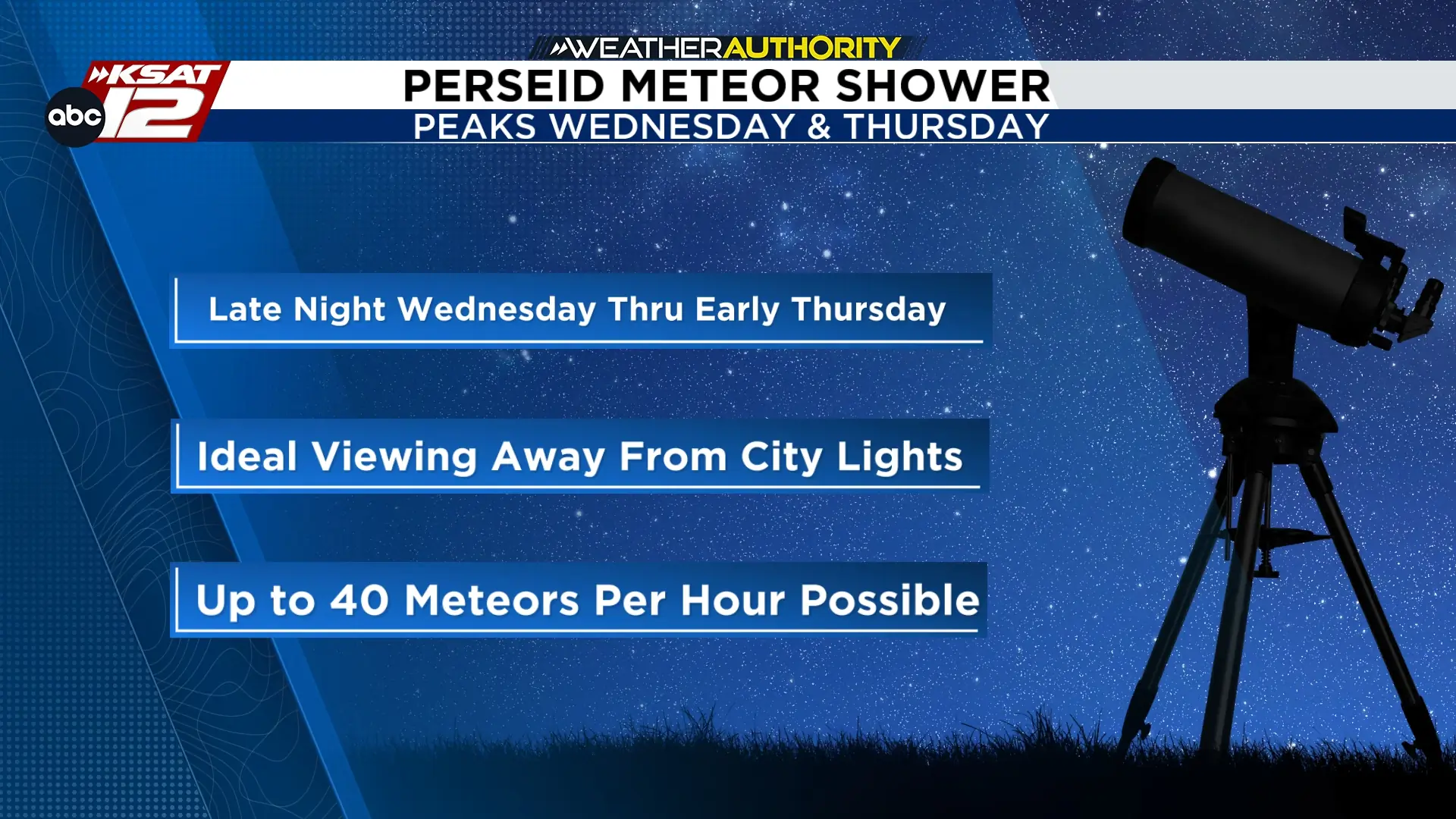
Stay up late or wake up early! A new moon and limited cloud cover will provide the best conditions to enjoy one of the most famous meteor showers. Here’s a breakdown of what this is and some helpful tips to enjoy the show:
Key Points
- The Perseid meteor shower peaks on the night of Wednesday, Aug. 12 and into the morning of Thursday, Aug, 13 this year.
- The best time to spot these meteors is around midnight and before dawn.
- Look towards the northeastern horizon where the Perseus constellation rises to try and spot the meteors.
- A new moon will be present, meaning there will be no moonlight to obstruct your viewing.
- With a completely dark sky, observers have seen up to 100 meteors per hour in the past.

Sign up for the Whatever the Weather newsletter here.
What causes the Perseids?
According to earthsky.org, the Perseid meteor shower comes from the large parent comet 109P/Swift-Tuttle. This comet was discovered in the 1860s and orbits the sun approximately every 133 years. The last time it passed close to Earth was in 1992.
Pieces of ice and space rock left behind by this comet cause this meteor shower, specifically as the Earth passes through the debris field. The peak of the Perseid meteor shower correlates to when the Earth passes through the densest part of this debris.
This year’s meteor shower
The meteor shower can be seen through Aug. 24, but it is at its peak the night of Aug. 12 into Aug. 13. Afterward, the number of meteors seen will gradually decline.
What makes this show the best in a while is that the moon will be in the new moon phase during this timeframe. This means no moonlight will obstruct your viewing, and you should be able to see even the faintest meteors. 🌘
The radiant point (where the meteors appear to generate from) is seemingly close to the constellation Perseus. The constellation will rise above the northeastern horizon around 11 p.m. before climbing high in the sky through the early morning hours.
When clear skies are present, the best time to view meteors is right before dawn when that radiant point is higher. When spotted, these meteors are typically colorful and leave behind glowing trails. Sometimes the longest and brightest meteors can be seen just a few degrees away from the radiant point.
Best viewing practices
In terms of weather conditions, we’ll continue to have the same pattern as previous days: Clear skies at night and into the very early morning hours, but cloud cover builds before sunrise. The best window to spot the meteors with minimal clouds will likely be between midnight and 4 a.m.
If you want the best possible seat for the show, head out to a dark spot that’s away from bright city lights. It’s also a good idea to find a place that isn’t obstructed by tall buildings and structures so you can see as much of the sky as possible.
Telescopes and binoculars are not required, just some patience and about 30 minutes to let your eyes adjust to the night sky! That means don’t look at your phone either!
Editor’s Note: These meteors are not to be confused with the Starlink satellites, which have also been reported in the South Central Texas skies. These satellites look like a “line of lights” in the sky. You’ll know the difference if you happen to spot a meteor, since meteors move much faster!
Meteor jargon
Meteor, meteorite, meteoroid ... what’s the difference? According to NASA, they’re all related to the flashes of light in the sky that we know as “shooting stars.”
Depending on where they’re located, we refer to them by different names:
- For example, meteoroids are essentially “space rocks” that can vary widely in size.
- When these meteoroids enter the Earth’s atmosphere and eventually burn up, the “shooting star” that we sometimes see is then called a meteor.
- If a meteor doesn’t fully burn up and part of it reaches the ground, it’s then referred to as a meteorite. It can be a little confusing, I know!
By the way, if you ever happen to see a rogue fireball in the night sky, report it to the American Meteor Society by clicking here!
Happy meteor watching!
- Read more from the meteorologists on the Whatever the Weather page
- Download KSAT’s weather app for customized, accurate forecasts in San Antonio, South Texas or wherever you are
- Find the latest forecasts, radar and alerts on the KSAT Weather Authority page
