
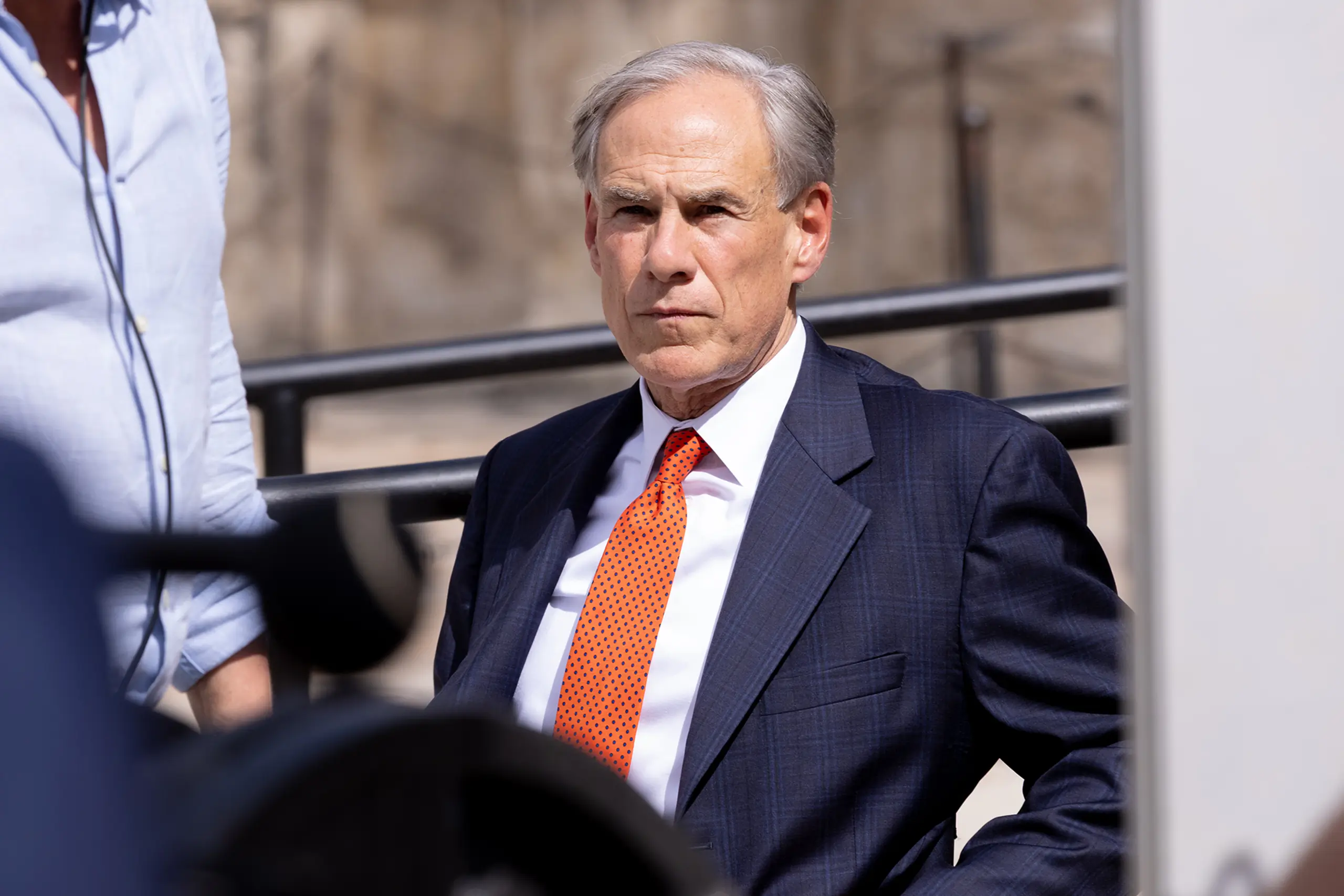
For the fourth time in less than four weeks, Gov. Greg Abbott has forced a Texas city to yield to his will by threatening to withdraw public safety grants administered by his office.
In Texas, where Republicans dominate state leadership and Democrats hold sway in many big cities, the GOP governor is turbocharging the use of financial threats to force compliance on matters that typically fall under local control.
Recommended Videos
The latest state-local clash came earlier this week after Texas conservatives protested plans to hold a Muslim-only celebration at a water park owned by Grand Prairie. Although organizers modified advertising to welcome anybody wearing modest attire to the June 1 Epic Eid event, Abbott weighed in Wednesday to demand the event be scrapped.
“That’s religious discrimination. It’s unconstitutional.” Abbott posted on X.
“The City must cancel the event and commit to never allowing something like it again by May 11th,” he added. If not, the governor warned, Grand Prairie would lose $530,000 in public safety grants.
Within hours, the North Texas city canceled the event, telling The Texas Tribune doing so was in its “best interest.”
More than 40 Democratic state lawmakers responded Thursday with a letter urging the governor to withdraw the threat, saying Abbott acted to improperly exclude participants from a public facility based on their religion. The event had been held without controversy in the two previous years, the letter added.
Abbott spokesperson Andrew Mahaleris said the funding hold had been lifted, “and the Governor expects full contract compliance moving forward.”
“Every Texan, regardless of their faith, is entitled to equal treatment in public spaces,” Mahaleris said in a statement. “Governor Abbott will continue to use every necessary tool to ensure local governments follow the law and do not facilitate discrimination at taxpayer expense.”
Abbott’s Grand Prairie showdown followed successful efforts last month to force Houston, Dallas and Austin to quickly change policies limiting police cooperation with federal immigration agents. The governor threatened to take back nearly $150 million in public safety grants from the three cities, and Dallas was warned that it also risked more than $55 million in public safety funding for World Cup events.
The spree of demands was not the first time Abbott has used this playbook.
The governor threatened to withhold state grants from the Dallas County sheriff in 2015 and the Travis County sheriff in 2017 to protest policies limiting cooperation with federal immigration agents. In October, Abbott warned cities and counties they could lose transportation funding if they don’t remove road markings that “advance political agendas,” including rainbow crosswalks that celebrate the LGBTQ+ community.
Abbott’s increasing threats of financial retribution, political experts say, are another sign of Republicans embracing the use of executive power to achieve policy goals — even in Texas, where the state’s constitution grants somewhat limited power to governors.
“This is an interesting use of executive power in a state that technically envisions the governor is weak constitutionally,” said Joshua Blank, research director with the Texas Politics Project at the University of Texas at Austin.
Two conditions make that possible, he said.
First, Blank said, Republican lawmakers “almost uniformly support” Abbott’s goals and aren’t likely to push back.
“But the second is this overall embrace within the Republican Party of executive action that’s hard not to look at as a consequence of Trump’s approach to the presidency,” he added.
Brandon Rottinghaus, a political science professor at the University of Houston, said the Texas governor role started evolving into a more “muscular” office under former Gov. Rick Perry, who used political appointments, executive orders and vetoes to increase the office’s impact. Abbott has “taken it even farther in some ways,” he said.
“He, more so than Perry, is the kind of true leader of the Republican Party,” Rottinghaus said. “Perry did so with finesse, and Governor Abbott’s doing so with force. … That’s a rarity in Texas. That’s a new phenomenon.”
Abbott’s recent funding threats have also produced quick wins on hot-button issues important to his Republican base — immigration and perceived threats posed by Islam — amid a tense election cycle.
Anti-Islam rhetoric has been a central issue in this year’s Republican primaries, with conservative activists pushing party leaders to take a harder line against Muslims and candidates claiming Muslim immigrants wish to impose their values on other Texans.
In addition, Blank said, Abbott’s focus on police interaction with ICE provides another inroad to Republican voters, fewer and fewer of whom now consider immigration or border security to be the state’s most pressing issue under the second Trump administration.
“It took away one of, if not the primary issue that Republicans in Texas have used to mobilize their voters,” he said. “So what we have now is a turn towards Texas cities, in this case, to raise the immigration issue.”
Disclosure: University of Houston and University of Texas at Austin have been financial supporters of The Texas Tribune, a nonprofit, nonpartisan news organization that is funded in part by donations from members, foundations and corporate sponsors. Financial supporters play no role in the Tribune’s journalism. Find a complete list of them here.