
SAN ANTONIO – Slowing, or even shrinking, property tax projections are pushing Bexar County and the City of San Antonio to consider ways to pull back on new spending, make cuts, or even raise the tax rate.
“This is not normal,” Bexar County Manager David Smith told county commissioners in an April briefing on the county’s financial forecast.
“This is a very different budget environment we’re about to walk into, and it’s going to require very different measures to stabilize the budget.”
The city and county both depend on property taxes to fund services like law enforcement, libraries, parks, or courts.
For the city, the revenue makes up about 28% of the money poured into the general fund, while the county’s general fund budget is even more property tax-dependent at approximately 80%.
And though neither projects a deficit in the upcoming year, both the city and county are preparing for shortfalls in the near future.
PROPERTY APPRAISALS
Property tax revenues are based on the value of property within the taxing district, which are set by the local appraisal district.
Rogelio Sandoval, the chief appraiser at the Bexar Central Appraisal District, said BCAD’s job is to reflect the market, and “this has been one of the years where it has been noticed that it has significantly softened from the prior years.”
Average home sale prices in Bexar County peaked in 2022 at roughly $345,200, according to the Texas A&M University Texas Real Estate Research Center, and have since fallen to $338,800 in 2025.
The total market value for all single-family residential homes has dropped by more than $203 million compared to 2025, according to BCAD, even when taking into account newly-built homes.
“I haven’t seen a market like this since maybe 2008, 2009, when the housing bubble,” Sandoval told KSAT.
In a recent presentation to the city council, San Antonio Interim Budget Director Alfredo Martinez blamed the “worsening housing market” for projected property tax revenue declines, as well as a new, $125,000 exemption for businesses on their income-producing personal property.
This and other exemptions, like the general homestead exemption Texans can get for their primary residence, give owners a discount on how much of their property value is actually taxed.
Neither the city nor the county knows exactly how much taxable value it will have yet, as property owners are still contesting their values. The deadline for most people to file a protest is Friday, May 15.
>> READ MORE: How to protest your property appraisal in Bexar County
BCAD will certify the appraisal roll to each taxing unit by late July.
CITY OF SAN ANTONIO
The City of San Antonio already expects that — after protests, appeals, and exemptions — it will see a 2.13% decrease in its taxable value.
Without raising its tax rate, that would mean a drop in the revenue the city collects, too.
The city’s general fund is also heavily supported through sales taxes and a portion of CPS Energy revenues. An assortment of other funding sources fills out the rest.
In a five-year forecast of the general fund, city staff anticipates the city could face a nearly $131 million deficit in the general fund in FY 2027. That could balloon to $264 million by FY 2031, if the current property tax rate of $0.54159 per $100 of value stays the same.
The city could raise its tax rate to collect more property taxes. However, that’s capped by state law, which generally only allows cities to collect up to 3.5% more tax revenue from existing properties without voter approval.
Without the certified appraisal values, staff told KSAT there’s not enough information yet to estimate what such a tax rate would be.
The city hasn’t raised its tax rate since FY 1993. Since then, it has either cut or maintained it.
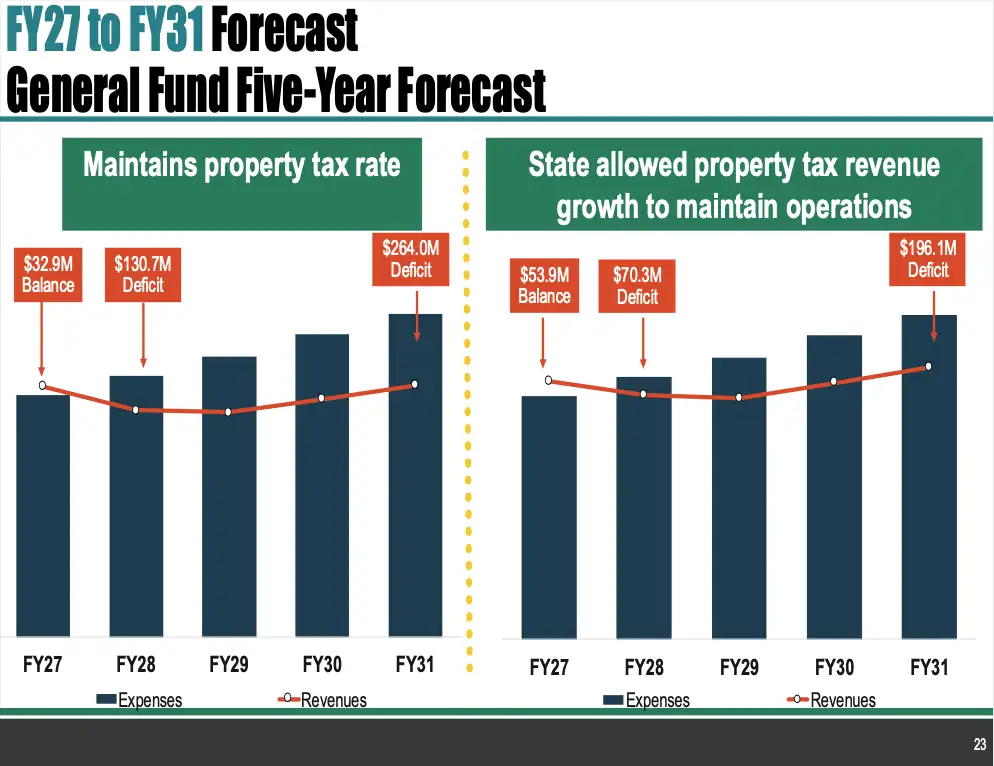
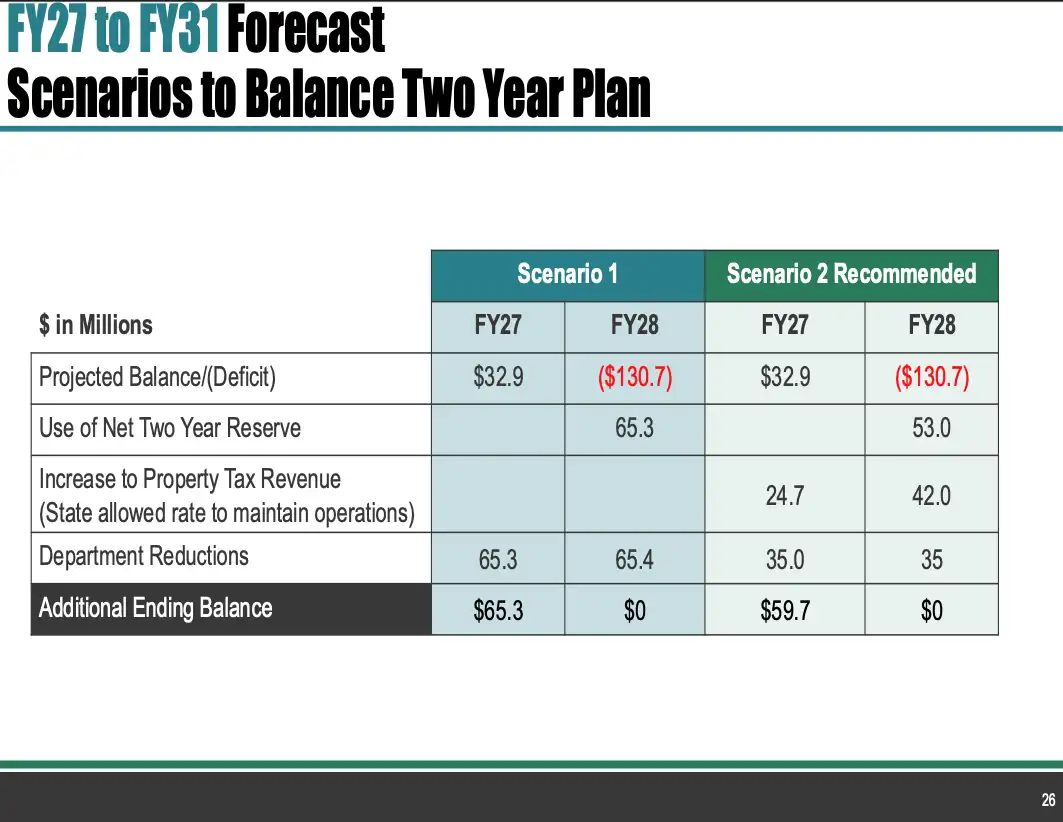
Even if the city maxes out its property tax rate, it wouldn’t be enough to close the deficit, according to staff projections. The city would still need to cut $70 million in spending over the next two years.
City staff also laid out an alternate scenario in a May 6 presentation in which the city would close the entire $130.7 million deficit through spending reductions.
Where such cuts would fall in either scenario isn’t clear yet, but the presentation listed “non-core, non-mandated services” and emphasized minimizing “impact to vulnerable populations.”
BEXAR COUNTY
By Bexar County’s projections, it won’t face a deficit in its general fund until FY 2029, when it would be a sizable $145 million.

Bexar County Budget and Finance Director Tanya Gaitan told KSAT the county has a “pretty hefty fund balance” that acts as the reserve for its general fund.
While Gaitan said the county isn’t considering cuts or a tax increase yet, it will need to pump the brakes on new spending.
“So in the last couple of years, we’ve seen some significant property tax growth, in value specifically. So we were able to grow pretty significantly with brand new positions, new programs for the community,” she told KSAT.
“But this year it’s starting to level out, where we’re not going to be able to grow. So the county is used to adding a pretty significant amount. This year, we’re looking to actually slow that down significantly."
Gaitan told commissioners that previous belt-tightening efforts have included:
- No cost-of-living adjustments
- Freeze vacant civilian positions
- No new program changes
- No new capital projects
- Adjust health insurance plans for employees
Both Bexar County and the City of San Antonio’s budget years run from October 1 through September 30.

